 blog
How to Choose the Best MLS Software for Associations
Quick Summary
The best MLS software for real estate associations serves listing data, member access, and governance at once. Evaluate accuracy, security, permissions, and mobile use, then compare vendors with a weighted scorecard built around audit trails, rules enforcement, and total cost of ownership.
- Score written vendor answers before demos so presentations cannot hide gaps.
- Weight data governance and interoperability heavily, since those are where implementations most often fail.
- Require itemized quotes covering implementation, data conversion, training, and recurring costs.
- Confirm data export formats, timelines, and fees at termination before signing.
- Migrate low-risk member directories first and keep legacy systems read-only during cutover.
Table of Contents
- What Associations Need From MLS Software
- Essential MLS Software Features to Evaluate
- MLS Vendor Comparison: Criteria That Matter
- MLS Software Implementation Costs and Total Cost of Ownership
- Integrating MLS Software With Association Management Systems
- Governance, Compliance and Member Adoption
- Scheduling a Platform Assessment for Your Association
- Frequently Asked Questions
What Associations Need From MLS Software
Last Updated: November 1, 2026
Choosing MLS software for a real estate association is not the same as picking a tool for a brokerage. Associations and MLSs answer to members, to data governance rules, and to boards that rotate every few years. The best MLS software for real estate associations has to serve all of those audiences at once.
Association needs fall into three groups: listing data, member access, and governance. Listing data has to be accurate, current, and secure. Members need reliable access from the office, the car, or a home desk. Governance means rules about who can change data, who approves new members, and how decisions get documented. Software that handles one group well and ignores the others creates work later.
Many associations also run legacy systems alongside spreadsheets that staff built years ago. A realistic evaluation accounts for that history. Ask vendors how their platform reads existing data and how it handles exports, and confirm migration timelines in writing for an organization of your size.
Essential MLS Software Features to Evaluate
Feature lists are easy to compare and easy to misread. A platform with 40 features may still fail on the three things your members use every day. Focus your evaluation on the capabilities that carry real operational weight.
Start with the core functions: listing management, search, member directories, and reporting. Then test how those functions behave under your real workload. A demo with 500 sample listings tells you little about performance with 500,000.
Listing Data Accuracy and Security
Accuracy is the foundation of any MLS. Errors in listing data erode member trust quickly, and they can create compliance problems. When you evaluate a platform, ask how it validates entries, flags duplicates, and tracks changes over time. An audit trail that shows who edited a record and when is a basic requirement, not a premium extra.
Security deserves the same scrutiny. Confirm how the vendor handles user authentication, data encryption, and backups. Ask for their incident response process in writing. A common mistake is accepting a general security statement without asking for documentation specific to listing data.
Member Access, Permissions and Mobile Use
Permissions determine who can see, edit, and approve what. Map your roles before you talk to vendors: broker administrators, association staff, board members, and general members each need different access. Platforms that force every user into the same permission tier create risk and frustration.
Mobile use matters more than many committees expect. Agents check listings between appointments, not at a desk. Test the mobile experience yourself with a few real listings and a slow cellular connection. Look for clear navigation, fast load times, and the ability to complete routine tasks without switching to a computer.
MLS Vendor Comparison: Criteria That Matter
Most vendor comparisons collapse into demo scorecards. A comparison that survives board scrutiny asks how each vendor performs against the criteria your association actually carries: governance, member services, data standards, and board oversight.
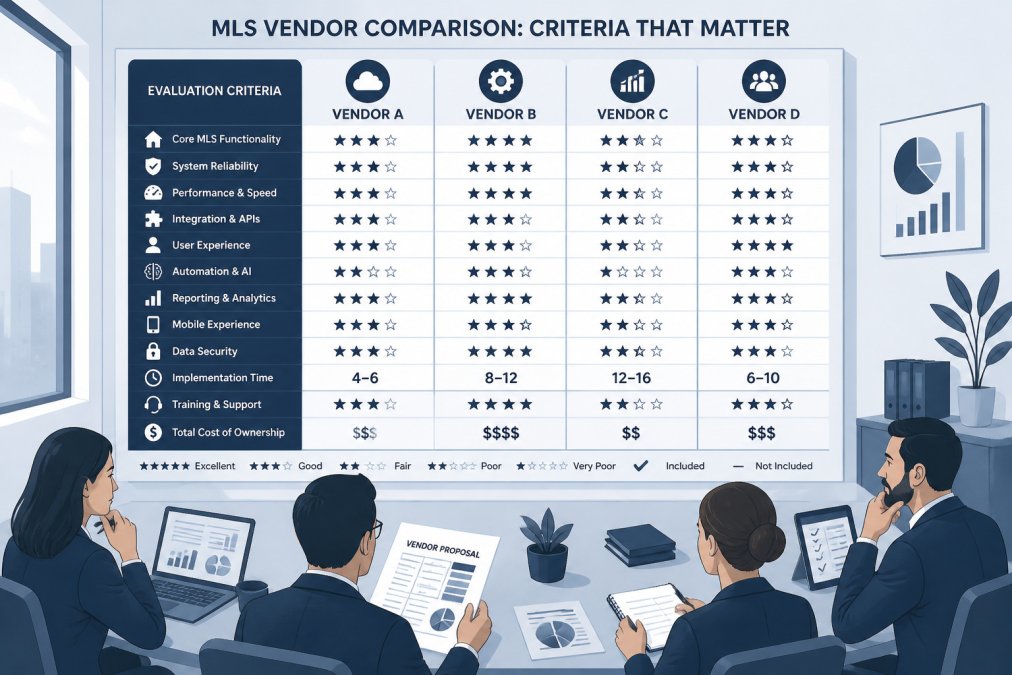
Build a weighted scoring sheet before you request proposals. Assign each criterion a weight that reflects your association's risk profile, require every vendor to answer the same questions in writing, and score the written answers before the demo so the presentation cannot paper over gaps. A practical starting set for an association looks like this:
| Criterion | What to Ask | Why It Matters to an Association |
|---|---|---|
| Data governance and audit trail | Who can change a listing record, and is every change logged with user, timestamp, and prior value? | Supports board oversight and dispute resolution |
| Rules enforcement | How are listing rules, status changes, and required fields enforced at entry rather than after the fact? | Reduces staff cleanup and compliance exposure |
| Identity and access | Does the platform support single sign-on, role-based permissions, and automated member onboarding and offboarding? | Cuts manual account work and stale access |
| Data ownership and exit | Who owns the listing data, and what export formats and timelines are guaranteed at termination? | Protects the association's core asset |
| Interoperability | Which feeds, APIs, and association management systems connect out of the box, and by what method? | Determines migration effort and staff rework |
| Service levels | What uptime, support response, and disaster recovery commitments are written into the contract? | Matters during peak listing activity |
| Total cost of ownership | What do implementation, data conversion, training, and renewal increases add over three to five years? | Prevents budget surprises |
| Member adoption support | What training, accessibility, and mobile support is included? | Drives login and listing-entry rates |
Weigh the criteria before you see any demo. A common pattern is for associations to weight data governance and interoperability heavily, then discover during reference calls that the vendor's strongest references are brokerages that never had to enforce MLS rules. Ask for references from associations of similar member count and similar governance structure, and ask those references what they would change about the implementation. Their answers usually reveal more than the vendor's own materials.
Two criteria deserve extra weight because they are where association implementations most often fail. The first is rules enforcement: a platform that lets staff fix bad data after entry costs more in labor than one that prevents the error at entry. The second is identity: if member onboarding and offboarding are manual, staff time scales with member count and access reviews become a recurring board issue. Ask each vendor to walk through both workflows end to end with your own role definitions, not their sample data.
MLS Software Implementation Costs and Total Cost of Ownership
License fees are the line item vendors quote and the line item boards remember. They are rarely the largest cost over a three- to five-year term. Implementation, data conversion, staff training, parallel running during cutover, and ongoing support commonly add more than the subscription itself, and those costs are where association budgets get surprised.
Pricing depends on membership size, data volume, integrations, and service levels, so require written quotes that itemize each cost category. For a step-by-step method, see evaluate implementation costs before committing. A useful TCO model separates costs into four buckets:
| Cost Bucket | What to Itemize | Association-Specific Driver |
|---|---|---|
| One-time implementation | Setup, configuration, project management, rules mapping | Number of listing rule sets and governance policies to encode |
| Data conversion and migration | Extract, clean, map, load, and validate legacy records | Volume and quality of historical listing and member data |
| Training and adoption | Role-based training, documentation, champions program | Number of member roles and offices, staff turnover |
| Recurring | Subscription, support, hosting, integrations, renewal increases | Member count, integration count, service-level tier |
Ask every vendor to quote each bucket separately and to state whether annual renewal increases are capped and at what percentage. Ask what happens to your data at termination: format, timeline, and any extraction fee. Data ownership and exit terms belong in the cost comparison because a low subscription with an expensive exit is not a low-cost platform.
Internal costs are the ones that never appear on a vendor invoice and are easiest to miss. Staff time for data cleanup before migration, parallel running during cutover, board approval cycles, and member support during the first 90 days all consume hours. Estimate those hours and multiply by loaded staff cost, then add them to the vendor total.
Build the comparison over a three- to five-year horizon, with renewal increases applied, and present it to the board as a single total rather than a set of annual fees. That framing makes the trade-off between implementation effort and subscription price visible, which is the decision the board is actually making.
Integrating MLS Software With Association Management Systems
Most associations do not start with a clean slate. They run association management systems for dues, events, and committees, and they keep spreadsheets for reporting. The MLS platform must work with those systems, or staff end up re-entering the same data in multiple places.
Ask each vendor for a documented list of integrations and the method used for each. Application programming interfaces (APIs) and scheduled data exports are common approaches, but they differ in reliability. Request a sample integration with one of your existing systems during the evaluation, not after the contract is signed.
Plan the migration in phases. Move low-risk data first, such as member directories, and validate it before moving listing records. Keep the legacy system running in read-only mode for a defined period so staff can check results. A common mistake is cutting over everything at once and discovering gaps weeks later.
Governance, Compliance and Member Adoption
Governance determines whether an MLS platform stays trustworthy over time. Write down your data rules before implementation: who may approve new listings, how disputes are resolved, and how policy changes get communicated to members. Software enforces rules better when the rules are clear first.
Compliance requirements vary by state and by the agreements an association holds with its members and with the National Association of REALTORS®. Have legal counsel review how the platform handles data retention, member consent, and access logs. Check the National Association of REALTORS®' current materials on MLS operations before finalizing policy.
Member adoption is where many implementations stall. Even a well-built platform fails if members do not use it. Plan training sessions by role, publish short how-to guides, and name champions in each office who can answer questions. Track login rates and the share of listings entered on the new platform during the first 90 days. Those numbers show whether adoption is happening or whether support needs to increase.
Scheduling a Platform Assessment for Your Association
Before you issue a request for proposals, consider a structured platform assessment. An assessment maps your current workflows, identifies data problems, and defines the criteria that should drive your vendor decision. Brexus Solutions works with associations and MLSs on this kind of evaluation, drawing on hands-on brokerage and MLS leadership experience.
A good assessment answers three questions: what your association needs, which vendors can deliver it, and what the transition will cost in time and money. Start by requesting a consultation to discuss your current systems and timeline. Our team can help you build the scoring criteria and review vendor responses so your decision rests on evidence rather than sales presentations.
Frequently Asked Questions
What is the best MLS software for a real estate association?
No single MLS platform fits every association. The best choice depends on how many members you serve, whether you run your own listing data or rely on a regional MLS, and how tightly you need to connect with association management tools. Start by listing your required workflows, member permissions and data governance rules, then shortlist vendors that meet them. Ask each vendor for references from associations of similar size and request a demonstration using your own data. Brexus Solutions can help you define those requirements; contact the firm for a consultation.
What features should an association look for in MLS software?
Prioritize listing data accuracy, role-based user permissions, reliable mobile access and audit trails that support data governance. Also check how the platform handles member onboarding, reporting and integration with your association management system. Features that look useful in a demo can add little value if members will not adopt them, so test workflows with a small group of real users before committing to a contract.
How much does MLS software cost for an association?
Pricing varies with membership size, data volume, customization and support levels, and vendors seldom publish fixed rates. Ask for a written quote that itemizes licensing, setup, data migration, training and ongoing support, and compare the total cost of ownership over several years rather than the first-year fee. For current pricing, contact Brexus Solutions through its website for a quote tailored to your association.